The Hum You Can Feel but Can’t Name
Many of us have been living with a strange, constant pressure—an ambient tension humming just beneath everything we do. It’s not the result of running marathons or rearranging furniture.
It’s the tiredness of bracing.
As Jared opens in Episode 104:
“It feels like being stuck inside a 360-degree disaster movie you can’t walk out of.”
And Alicia names the deeper issue:
“It’s the Spectator Trap—confusing consuming information with actually living.”
Episodes 103 and 104 unravel why this overwhelm is happening—and more importantly, how to participate in your life again without burning out.
This guide combines the wisdom of both episodes into one integrated resource.
Two Journeys Into Participation
The Printing Press & the Panic of 1440 (Ep. 103)
We often celebrate Gutenberg’s printing press as a triumph of progress. But living through that transition?
It was destabilizing, frightening, and wildly chaotic.
Before the press:
- Meaning flowed downward from authority.
- Books were scarce and protected.
- People didn’t choose what to believe—they were told.
After the press:
- Literacy spread.
- Ideas multiplied.
- Power structures trembled.
- Ordinary citizens became participants in shaping culture.
Alicia frames it perfectly:
“Participation always feels destabilizing before it feels normal.”
We are living through a similar shift now.
AI. Digital acceleration. Fracturing narratives.
It’s not a bug in the system—it’s a sign of evolution.
The Boom-Pole Revelation (Ep. 103)
Jared’s filmmaking class demolished Hollywood fantasy and replaced it with aching shoulders and a boom pole that felt heavier by the minute.
But standing in that freezing hallway, he realized:
“The movie isn’t the magic thing on the screen.
The movie is the ecosystem.”
Participation wasn’t glamorous.
It wasn’t spotlight-driven.
It was humble, sincere, necessary effort.
Just holding the boom pole mattered.
This is participation in its purest form.
The Book That Comes in Pieces (Ep. 104)
Alicia’s story of writing her book is a masterclass in nervous-system-aware creativity.
She tried to force clarity:
- sitting at the computer
- shoulders tensed
- jaw clenched
- cursor blinking like a judgmental metronome
And nothing worked.
So she stopped.
She let the draft breathe.
She waited—not in avoidance, but in trust.
“It wasn’t avoidance. It was listening.”
And the missing piece arrived when her system was regulated enough to receive it.
Participation begins with presence.
Presence begins with regulation.
Why We Feel Overwhelmed
Biology vs. Math (Ep. 104)
Our nervous system evolved in a slow, linear world:
- sunrise, sunset
- predictable seasons
- cause and effect happening locally
But our lives are now exponential:
- information travels instantly
- identities multiply
- feedback loops intensify
Jared summarizes:
“Our biology evolved for linear environments. But our world is exponential.”
This mismatch creates:
- chronic bracing
- early-morning dread
- indecision
- emotional numbing
- shutdown
It’s not a personal flaw.
It’s an evolutionary mismatch.
The Nervous System’s Hidden Process: Neuroception (Ep. 104)
Stephen Porges’ polyvagal theory explains why we brace even when nothing is “wrong.”
Your nervous system constantly scans for:
- safety
- danger
- unpredictability
This process happens below consciousness.
Meaning:
You can be sitting safely on your couch, but if the news, notifications, or uncertainty spike… your body hits threat mode.
Alicia says:
“You can’t think your way into safety. Your body has to feel it.”
The Spiritual Bridge: Participation as Coherence
Participation isn’t about productivity or performance.
It’s about integration.
Alicia:
“Disengagement fragments the spirit. Participation restores coherence.”
Participation is not heroic effort.
It’s relational presence.
TOOLS & PRACTICES FOR REGULATION & PARTICIPATION
Here are the structured practices from Episodes 103 and 104—merged into one usable sequence.
TOOL 1: Orientation — Return to the Room
When we’re overwhelmed, attention collapses inward.
To re-regulate:
- Soften your gaze
- Look around
- Name 3 things you can see
Alicia:
“Orientation tells your amygdala, ‘there is no predator here.’”
TOOL 2: Regulating Breath — Lengthen the Exhale
No force. No performance. Just:
- natural inhale
- slightly longer exhale
Then say:
“I am safe enough right now.”
“Enough” is the magic word—plausible, believable, grounding.
TOOL 3: Manifestation Debug Mode — Clearing the Static
Static sounds like:
- “I should be doing more.”
- “I need to try harder.”
- “This isn’t working.”
Instead of arguing:
- Notice the thought
- Feel where it lands in the body
- Identify the contraction
Jared:
“That sensation is not truth. It’s noise.”
Then reframe:
“I don’t need to force clarity.
I need to allow coherence.”
TOOL 4: Just Noticing Participation
Where are you already participating?
- a kind word to a barista
- a boundary held
- a creative impulse followed
- watering a plant
Alicia:
“Participation isn’t scale. It’s relationship.”
TOOL 5: Guided Visualization — Stepping Into the Field
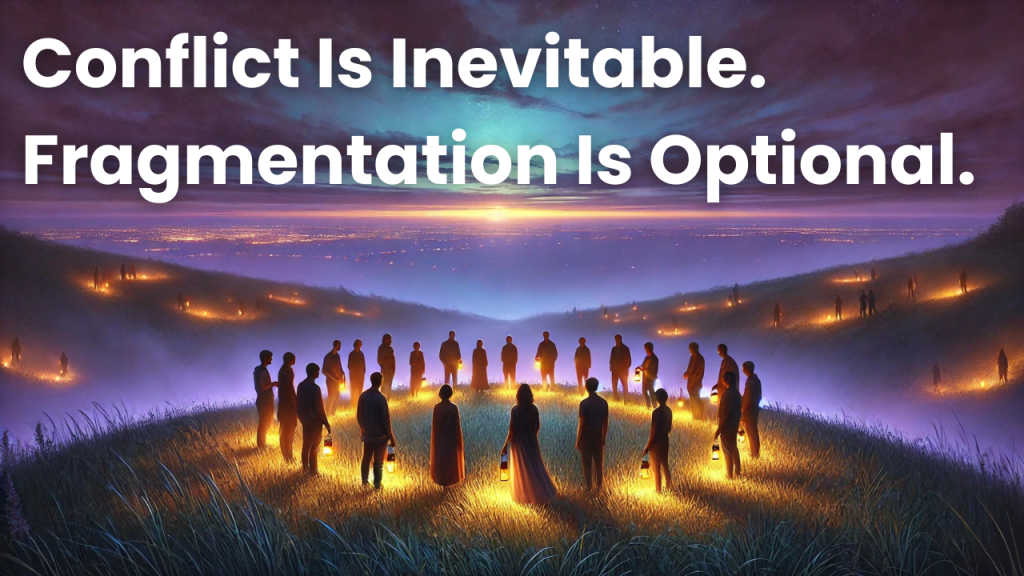
Imagine:
- a vast, welcoming field
- the ground responding to your step
- ripples of recognition moving outward
Alicia:
“You do not interrupt the field. You activate it.”
Jared:
“You are not late. You are expected.”
These phrases become internal anchors.
REFLECTION PROMPTS
Use these slowly and intentionally:
- Where have I been waiting for permission to engage?
- What feels meaningful—not urgent—for me to participate in?
- How do I want participation to feel?
- What signals tell me my nervous system needs care, not motivation?
- What changes if I treat participation as relationship instead of pressure?
WEEKLY ACTION STEP
Just once this week:
Pause before responding to something that feels urgent.
- Orient
- Breathe
- Say “I am safe enough right now”
- Then act
This micro-regulation is the hinge between overwhelm and agency.
CORE TAKEAWAY
“The future doesn’t need you to be louder. It needs you to be present.”
Presence stabilizes the network.
Participation restores coherence.
Your frequency matters more than your performance.
You are not here to stop the current.
You are here to meet it.
And most importantly:
“You are not late. You are expected.”



 Vibrations and Manifestations
Leave a comment