A Field Guide for Reconnection and Visibility
There are moments in life when relationships fracture.
Sometimes it happens in loud arguments and sharp words.
Other times it happens quietly—through months or years of silence.
In Episode 109, we explored the courage required to reopen connection.
In Episode 110, we explored the courage required to remain visible after reconnection.
Together, these episodes describe a powerful progression:
Repair → Visibility → Integration
Repair reopens the channel.
Visibility stabilizes your new identity.
Integration allows relationships—and your life—to evolve.
This field guide brings together the key lessons from both conversations.
Storytelling
The Man in the Cell
In 1964, Nelson Mandela was sentenced to life in prison and sent to Robben Island.
His prison cell measured about seven feet across.
Cold concrete.
A thin mat on the floor.
Blinding white limestone reflecting sunlight in the quarry outside.
For 27 years he lived there.
Almost 10,000 days.
He missed the funerals of his mother and son.
Letters from his family arrived with entire paragraphs blacked out by prison censors.
By every human expectation, prison should have hardened him into permanent bitterness.
Instead, Mandela began studying the language and psychology of the guards.
Not to defeat them.
To understand them.
When he was finally released in 1990, the country expected revenge.
Instead, Mandela supported the creation of the Truth and Reconciliation Commission.
Victims and perpetrators sat in community halls face-to-face.
Truth was spoken.
Pain was witnessed.
Repair began.
As Mandela said:
“Resentment is like drinking poison and then hoping it will kill your enemies.”
Repair was not weakness.
It was advanced strength.
The Text Message
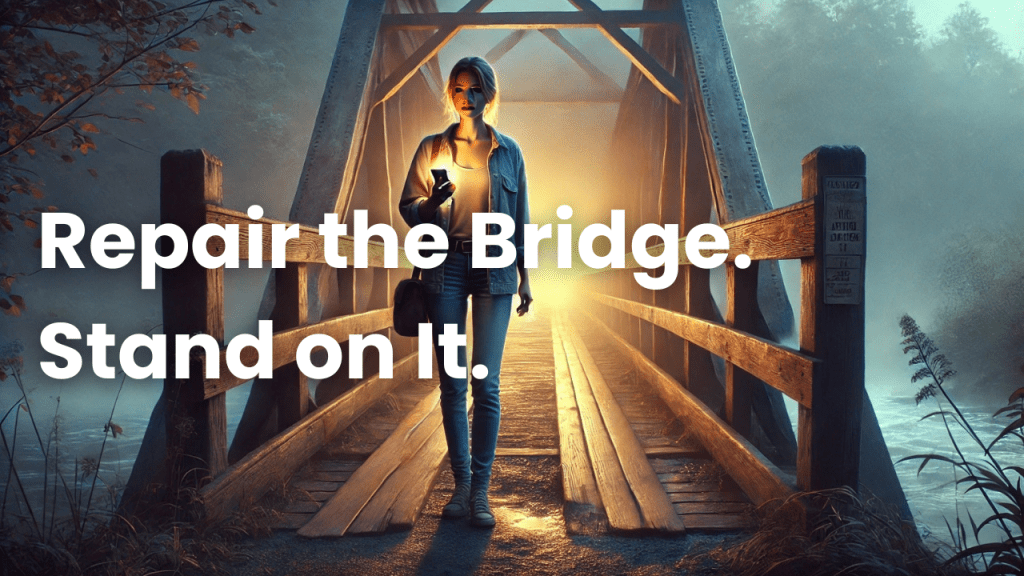
Not every bridge is geopolitical.
Sometimes it is a text message.
One of our hosts shared a story about a close friendship that drifted apart.
There was no big argument.
Just silence.
Weeks turned into months.
Months turned into two years.
The mind filled the silence with stories:
They must not care anymore.
It would be weird to reach out now.
Finally, a simple text was sent:
“I know it’s been a long time. I’ve been thinking about you.”
Twenty minutes later came the reply:
“I’ve missed you too.”
The bridge had never collapsed.
It had simply collected dust.
The Produce Aisle Moment
Repair is not the final step.
Episode 110 revealed the next initiation.
One host ran into a former coworker at the grocery store who greeted her as the person she used to be—the overworked, burned-out version.
For a split second, her body wanted to step back into that old identity.
Not because it was true.
Because it was familiar.
This moment reveals something important.
Repair opens the bridge.
But visibility tests whether you can stand on it.
Science + Spirit
Why “Too Late” Feels So Real
The brain is a prediction machine.
Three cognitive distortions convince us repair is impossible:
Catastrophic Projection
We imagine rejection before it happens.
Identity Rigidity
We freeze people in their past behavior.
Time Inflation
We confuse delay with destiny.
As we said in the episode:
“Time doesn’t close doors. Avoidance does.”
The Neuroscience of Social Pain
Research from social neuroscientist Matthew Lieberman shows that social rejection activates the same brain region associated with physical pain.
Your brain treats exclusion as injury.
That’s why reaching out after years of silence can feel terrifying.
Your nervous system thinks your survival is at stake.
The Tribal Brain
Humans evolved in tribes.
For most of human history, exclusion meant death.
Your nervous system still carries that ancient alarm system.
Modern situations—like speaking your truth at a family dinner—can trigger the same survival response.
Your chest tightens.
Your throat constricts.
Your body prepares for danger.
Understanding this biology helps us respond with compassion instead of self-judgment.
The Spiritual Dimension
Mythologist Joseph Campbell described a universal transformation cycle.
The hero leaves home.
Faces trials.
Finds wisdom.
But the journey isn’t complete until the hero returns to the village.
Private growth is safe.
Public embodiment is transformational.
As we said in Episode 110:
“Growth becomes real when it is witnessed.”
Tools for Repair and Visibility
The Five Levels of Repair
From Episode 109:
Level 1 – Inner Repair
Replace “It’s too late” with “I am not finished.”
Level 2 – One Relationship
Send a small signal:
“I’ve been thinking about you.”
Level 3 – Family and Community
Prioritize stability over winning arguments.
Level 4 – The National Divide
Oppose policies without dehumanizing people.
Level 5 – Humanity
Replace cynicism with disciplined hope.
Three Tools for Staying Steady While Seen
From Episode 110:
1. Anchor Before Exposure
Press your feet into the floor.
Take a slow breath in.
Exhale longer than you inhale.
Long exhales stimulate the vagus nerve and calm your nervous system.
2. Let Silence Hold You
When tension arises, pause.
Do not rush to justify your growth.
You do not owe anyone a dissertation on your evolution.
3. Speak with Clarity
Replace minimizing language.
Instead of:
“I’m just trying something new…”
Say:
“This is how I work now.”
Clarity stabilizes identity.
Manifestation Debug Mode
The hidden belief beneath avoidance is:
“If they see the real me, I will lose connection.”
The reframe:
Authenticity filters relationships.
It does not destroy them.
Some people move closer.
Some step away.
Filtering is refinement.
Action Steps
Choose one small step this week.
Not dramatic.
Just real.
Examples:
• Send a message to someone you’ve drifted from
• Speak honestly about who you are now
• Start a project you thought was “too late”
• Hold a boundary without over-explaining
Repair begins with movement.
Visibility stabilizes growth.
Soundbites from Episodes 109 & 110
“Too late is often just fear wearing a calendar.”
“Dust isn’t destruction. It’s just disuse.”
“Time doesn’t close doors. Avoidance does.”
“Authenticity filters relationships. It doesn’t destroy them.”
“You can hold your values without breaking the bond.”
“Growth becomes real the moment you let it be seen.”
Integration
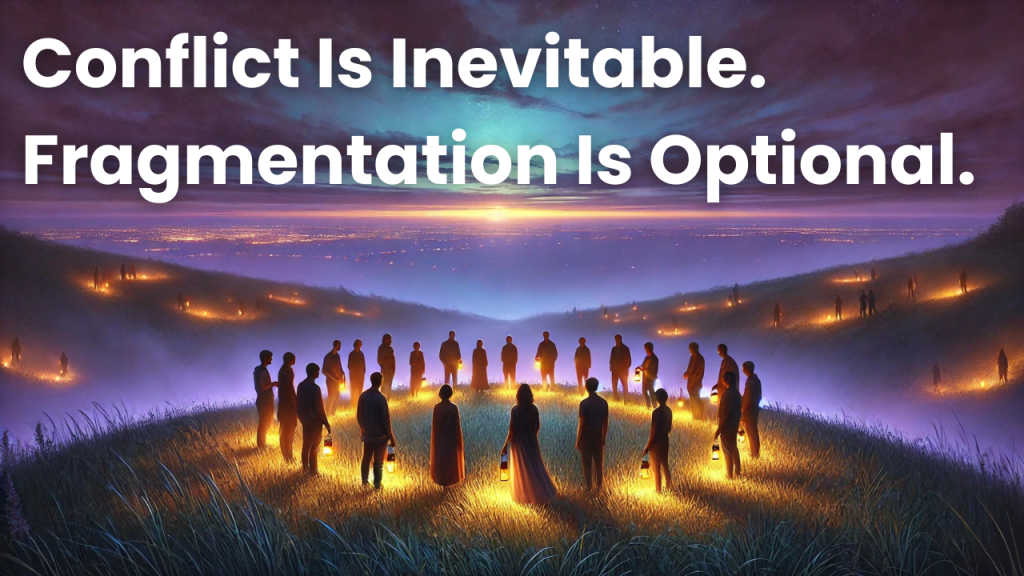
Episodes 109 and 110 describe a full arc of transformation.
First you reopen the bridge.
Then you stand visibly on it.
Repair restores connection.
Visibility stabilizes growth.
Integration transforms both.
The bridge was never destroyed.
It was waiting.
All it needed was footsteps.


 Vibrations and Manifestations
Leave a comment