Meaningful Circles, Mutual Benefit, and the Lost Art of Giving and Receiving
There is a very particular kind of loneliness that only modern life could invent.
It does not look like being stranded on a mountaintop or wandering through an empty desert. It looks like waking up with twelve notifications, three unread texts, a calendar full of obligations, and a social feed that has technically kept you “connected” to hundreds of people before your feet even touch the floor.
And still, somewhere under your ribs, there is that quiet ache:
Does anyone actually know what I’m carrying today?
That ache matters.
It is not drama. It is not neediness. It is not proof that you are failing at adulthood, manifestation, productivity, independence, or “having a good attitude.”
It is your nervous system telling the truth.
You were not built to be visible to everyone and understood by no one. You were not built to perform your way into belonging. You were not built to turn every relationship into a pitch, every conversation into networking, every desire into a solo hustle, and every need into something you must hide until you have made it pretty.
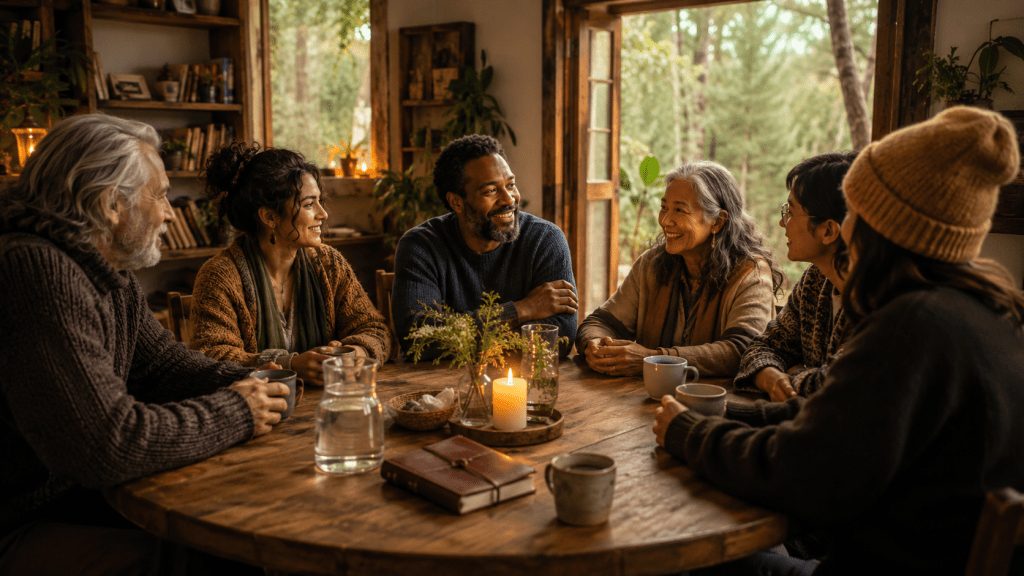
You were built for circles.
Small circles. Real circles. Load-bearing circles.
The kind where people remember the doctor’s appointment you were nervous about. The kind where someone shows up with a wrench and coffee before you have to admit the pipe burst. The kind where a shared meal, a saved seat, a thoughtful text, a ride, a book recommendation, or a simple “I thought of you” becomes a doorway back into being human.
And maybe that is the lesson underneath both community and mutual aid:
The universe often answers through people.
But first, we have to remember how to meet each other as people again.
The Great Modern Confusion: Contact Is Not Connection
We are surrounded by signals.
Pings. Likes. Views. Messages. Comments. Follows. Updates. Feeds. Invitations. Reminders. Alerts.
There is so much input that it can feel absurd to say we are lonely. How could we be lonely when we are reachable at all times?
But being reachable is not the same as being held.
Being seen is not the same as being understood.
Being known as an avatar, a profile, a job title, a creator, a parent, a partner, a competent one, a funny one, a helpful one, a strong one, or a person who always seems fine is not the same as being known in the soft, nervous-system-settling way that says:
I see the real thing you are carrying.
You do not have to perform right now.
You are safe here.
Modern connection often hits the receptor without delivering the nourishment.
It is like social artificial sweetener. It tastes like connection for a second. The brain registers a signal. Someone liked the post. Someone viewed the story. Someone responded with a fire emoji. Someone swiped right.
But then the deeper body waits for the actual meal.
The eye contact.
The laughter that changes the air in the room.
The meal shared without a screen between you.
The familiar face at the coffee shop.
The friend who hears your voice and knows you are not fine.
The person who says, “No pressure, but I saved you a seat.”
That is the difference between contact and connection.
Contact says, “I received data from you.”
Connection says, “I recognize your humanity.”
Understanding goes even deeper.
Understanding says, “You can stop holding your breath.”
The Barn Was Never the Whole Manifestation
Imagine a barn raising.
A cold field at dawn. A blueprint. Frost on the grass. A family staring at the materials for a structure they desperately need before winter.
One person cannot build it alone. Not because they are lazy. Not because they lack vision. Not because they failed to align their vibration.
Because some structures are not designed for one body.
The beams are too heavy. The work is too complex. The timeline matters too much. The survival of the family depends on something larger than personal grit.
Then the neighbors arrive.
One brings tools.
One brings lumber.
One brings skill.
One brings strength.
One brings stew and bread.
Someone watches the children.
Someone plays music.
Someone cracks a joke at exactly the right moment.
By sundown, the barn stands.
But here is the part we often miss:
The barn was not the only thing manifested.
The circle was the manifestation.
The community that gathered around the need was the true miracle. The barn was the visible structure, yes. But underneath it was the invisible structure: trust, reciprocity, repetition, shared survival, and the willingness to carry what no one person could carry alone.
That is where so many of us get tangled in manifestation work.
We are holding a blueprint for a future that is too big for one nervous system, one calendar, one pair of hands, one bank account, one phone, one brain, one exhausted person trying to be visionary, healed, productive, attractive, regulated, marketable, and spiritually aligned all at once.
Then we wonder why the dream feels heavy.
Maybe the dream is not wrong.
Maybe the container is too lonely.
When Independence Becomes a Cage
Independence is beautiful.
It gives you agency. It helps you make choices. It helps you leave places where you are not respected. It helps you build skills, trust yourself, and take responsibility for your life.
But independence has a shadow.
At some point, “I can handle it” can become “No one is allowed to help me.”
At some point, privacy becomes a locked door.
Competence becomes armor.
Self-reliance becomes isolation.
“I’m fine” becomes a Faraday cage for the soul.
The cage can feel safe at first. No one can drop you if you never lean. No one can disappoint you if you never ask. No one can use your vulnerability against you if you never show it.
But nothing can reach you either.
Not comfort.
Not help.
Not encouragement.
Not opportunity.
Not the person who genuinely wants to show up.
This is one of the sneakiest manifestation blocks: asking the universe for support while making yourself emotionally unavailable to the human channels through which support would arrive.
A client is a person.
A mentor is a person.
A friend is a person.
A collaborator is a person.
A healer, teacher, neighbor, recommender, introducer, encourager, witness, and helper are all people.
The universe does not always deliver through lightning bolts. Often, it delivers through someone remembering your name in a room you are not in.
That requires relationship pathways.
Relationship pathways require us to let other people see enough of the truth to know where support can enter. If we hide every need, deflect every compliment, decline every offer, and insist that we are “fine” no matter what, we may technically want help, but we are not giving help a doorway. To become receivable is to lower the armor just enough for care, encouragement, opportunity, and connection to actually reach us.
The Transactional Trap
Here is the other thing making this harder:
So many of the places where trust used to grow have been turned into transactions.
Dating became swiping.
Friendship became following.
Job searching became keyword optimization.
Creativity became content output.
Mentorship became a paid funnel.
Community became a platform feature.
Attention became currency.
Belonging became something we had to brand, optimize, and earn.
This does not mean technology is evil. Online spaces can be beautiful. They can connect people who never would have found each other otherwise. They can give isolated people language, community, and hope.
But when every doorway becomes monetized, people forget how to approach each other without an agenda.
We start asking:
What can I get?
What do I owe?
How do I prove I am worth choosing?
How do I package myself correctly?
How do I make myself useful enough to deserve support?
That is exhausting because it keeps the nervous system in performance mode.
And performance mode is not the same as intimacy.
A transaction ends when both sides get what they came for.
A relationship begins when both sides become more human to each other.
Mutual Benefit Is Not a Power Game
There is a clean kind of giving.
It does not say, “Now you owe me.”
It does not say, “Look how generous I am.”
It does not say, “I am above you because I helped.”
It says:
This is mine to offer.
It belongs in the flow.
I trust that what moves through love is not lost.
There is also a clean kind of receiving.
It does not collapse into shame.
It does not scramble to repay immediately.
It does not turn kindness into debt.
It does not make you small.
It says:
Thank you.
I can let this land.
I can be supported without being diminished.
That balance is mutual benefit.
No savior.
No subordinate.
No throne.
No begging bowl.
No hidden contract.
No emotional invoice.
Just support moving horizontally.
This is where the spiritual language of yin and yang becomes useful.
Healthy yang acts, builds, protects, clarifies, initiates, and takes responsibility.
Healthy yin receives, listens, nourishes, notices, allows, and trusts the relational field.
Distorted yang says, “I must dominate, optimize, force, control, and never need anyone.”
Distorted yin says, “I must overgive, disappear, wait to be chosen, and call self-abandonment love.”
But mutual benefit brings the energies back into balance.
I bring what I can.
I receive what I need.
We become stronger together.
That is not weakness.
That is life intelligence.
Kropotkin, Horses, and the Pattern Life Keeps Showing Us
Peter Kropotkin saw something that the dominant story of his time kept missing.
The popular interpretation of nature was competition. Survival of the fittest. Every creature for itself. A war of all against all.
But when Kropotkin observed harsh environments, especially in Siberia, he saw a different pattern.
He saw cooperation.
He saw animals and humans surviving not through isolated dominance, but through mutual defense, shared knowledge, resource-sharing, and group intelligence.
One of the most vivid examples is the image of Mongolian horses on the steppe. When wolves approached, the horses did not scatter in a panic, leaving the weakest to be picked off. They formed a defensive circle, protecting the vulnerable in the center and facing the danger together.
That image belongs in the body.
Because every one of us has moments when we are the strong outer ring.
And every one of us has moments when we are the vulnerable one in the center.
A healthy community knows this.
A healthy friendship knows this.
A healthy family, creative team, partnership, or circle knows this.
No one is always the helper.
No one is always the helped.
No one is always the brave one.
No one is always the one who needs protection.
The circle turns.
That is why mutual aid is not charity. It is not one person with power handing crumbs to someone without it. At its best, it is the recognition that life is unpredictable, winter comes for everyone, and survival is wiser when support can move.
Today I share the food.
Tomorrow you bring the firewood.
Next week someone else knows the path across the river.
No one survives every season alone.
The Loss of the Common Room
Part of what makes this moment feel so strange is that we gained infinite choice and lost some of the common rooms where trust used to form.
There was a time when more people watched the same shows, heard the same songs, read the same local paper, attended the same neighborhood events, worked in more face-to-face environments, or met partners through friends, school, work, family, church, clubs, or shared spaces.
That past was not perfect. It excluded many people. It could be narrow, judgmental, racist, sexist, homophobic, rigid, and suffocating. We should not romanticize it.
But we can still notice what it provided: repetition, context, and low-stakes overlap.
You saw the same people again and again.
Trust had somewhere to grow.
Now we often start from zero trust every time.
A new profile.
A new applicant portal.
A new feed.
A new comment section.
A new dating match.
A new group chat.
A new platform where everyone is performing enough to be visible, but not always safe enough to be real.
No wonder we are tired.
Trust is not hacked.
Trust is grown.
The Relationship Energy Map
So how do we begin again?
Not by forcing ourselves into huge social overhauls. Not by deciding that tomorrow we will magically become the most extroverted, open-hearted, potluck-hosting, group-chat-maintaining version of ourselves.
We start smaller.
Try drawing three circles.
In the center circle, place the people who make you feel safe, honest, and unedited. These are the people who can see the mess without making you feel like you have failed.
In the middle circle, place the people you enjoy and might like to know more deeply. The coworker with great banter. The classmate. The fellow creator. The neighbor. The person you always think, “We should really get coffee sometime.”
In the outer circle, place the weak ties. The barista. The person in your online course. The friendly person at the gym. The neighbor you wave to. The distant cousin who always responds warmly. The person who keeps appearing at the edges of your life.
Then look at the map and ask:
Where is there already a spark?
Community may not be absent.
It may be untended.
The One Thread Practice
You do not need to build the whole village today.
Strengthen one thread.
Send the text.
Leave the voice note.
Share the article.
Invite the person to coffee.
Ask the real question.
Return to the same class.
Sit at the community table.
Follow up when you say you will.
Tell someone, “That made me think of you.”
Do not make it a pitch.
Do not make it a test.
Do not make it a dramatic bid for lifelong loyalty.
Just strengthen one thread.
Then another.
Then another.
This is social fitness. We do not become relationally strong through one grand gesture. We become relationally strong through repeated acts of presence, curiosity, and repair.
A meaningful circle is cultivated.
Better Than “How Are You?”
If we want to be understood, we also have to become people who know how to understand.
The phrase “How are you?” is usually too easy to dodge.
Fine. Busy. Hanging in there. Same old. Can’t complain.
So try asking better questions.
What has been taking up the most space in your mind this week?
What do you wish someone understood about this season of your life?
What feels heavier than people realize?
What are you excited about but afraid to say out loud?
What would feel supportive right now?
These questions open doors.
They tell the other person, “You do not have to perform the summary version of your life with me.”
And sometimes, when we feel lonely, the way back into connection is not waiting for someone to understand us first.
Sometimes the doorway opens when we become willing to understand someone else.
The Opposite Signal
When loneliness hits, the body often tells us to withdraw.
Cancel the plans.
Do not reply.
Stay home.
Disappear.
Protect yourself.
Do not risk being rejected.
Do not let anyone see that you need anything.
Sometimes rest is wise. Sometimes solitude is medicine.
But sometimes isolation is a glitch pretending to be protection.
In those moments, try the opposite signal.
When you want to disappear, send one honest message.
When you want to assume no one cares, ask one person a real question.
When you want to spiral alone, go somewhere human.
When you want to wait for someone to notice, make one clean invitation.
Not because you are chasing.
Because you are participating.
Manifestation Is Not a Solo Magic Trick
Here is the reframe:
Manifestation is not just calling something toward yourself.
Manifestation is participating in the field where something beautiful can circulate.
Your dream may begin inside you, but it becomes real through relationship.
A job opportunity travels through a person.
A healing resource travels through a person.
A creative breakthrough often arrives through conversation.
A new friendship begins with repeated contact.
A romantic relationship needs context, trust, and time.
A community forms when enough people stop waiting and start tending.
If your manifestation feels stuck, ask:
Am I trying to receive support while staying unreachable?
Am I asking for a circle while refusing to be known?
Am I treating people like transactions because I am afraid of needing them?
Am I overgiving so I can stay in control?
Am I refusing to receive because I do not want to feel indebted?
Am I widely visible but rarely understood?
These are not shame questions.
They are doorway questions.
The Old Well
Picture an old stone well in the center of a village.
People come to draw water. People also help maintain the well.
No one owns the water.
No one is shamed for needing it.
No one is superior because they carried a bucket.
No one is diminished because they took a drink.
The well exists because everyone understands something modern life keeps trying to make us forget:
Life depends on shared resources.
A meaningful community is a kind of well.
So is a trusted friendship.
So is a creative circle.
So is a mutual aid network.
So is a family system when it is healthy.
So is a group of people who know how to give and receive without turning every exchange into power.
Bring something to the well.
A skill.
A kindness.
A question.
A meal.
A ride.
A book.
An introduction.
A prayer.
A piece of wisdom.
Your honest presence.
Then draw water.
Receive courage.
Receive encouragement.
Receive friendship.
Receive rest.
Receive opportunity.
Receive the relief of not having to generate all the light alone.
A Small Practice for This Week
This week, practice one clean act of giving and one clean act of receiving.
For giving:
Share someone’s work with a person who would appreciate it.
Offer a specific compliment.
Make an introduction that could benefit both people.
Send the article, book, podcast, or resource with no strings attached.
Ask someone a question that helps them feel understood.
For receiving:
Accept the compliment without deflecting.
Let someone help you.
Ask the question you have been pretending you do not need to ask.
Say yes to the invitation if your body feels safe enough.
Let support land before you rush to repay it.
And if you are feeling brave, strengthen one thread.
Choose one person from your middle or outer circle and make one small, honest bid for connection.
No performance.
No pitch.
No pressure.
Just a thread.
The Takeaway
You do not need a larger audience watching your life.
You need the right circle of people helping you actually live it.
You do not need to prove you are strong enough to survive alone.
You need to become open to safe alliance, reciprocal care, and meaningful support.
You do not need to turn every exchange into a transaction.
You can return to the older, wiser rhythm of giving and receiving.
The barn rises because the circle arrives.
The horses survive because the herd forms.
The well nourishes because everyone understands that water is not meant to be hoarded.
And your life, too, becomes lighter when you stop trying to build the entire architecture alone.
Love circulates.
Power hoards.
And when we return to clean giving and receiving, we remember the truth that was there all along:
We were never meant to do life alone.


Leave a comment