
The circumstance may be:
I need help right now.
The identity does not have to be:
I am helpless.
I have two adult children, and I still help both of them financially.
I do it because I love them. I want them to have the best chance at a stable, meaningful life. I want them to feel supported while they build careers, manage setbacks, and figure out what adulthood actually looks like for them.
But I also wonder about it.
Am I helping them build that life?
Am I making it easier for them to grow?
Or am I sometimes making it harder for them to feel fully adult?
There is no tidy answer. I wish there were. It would be convenient if parenting adult children came with a dashboard that said, “Support level: healthy” or “Warning: you are now accidentally rescuing.”
Instead, there is love, worry, money, history, and the occasional conversation where everyone is trying very hard not to sound defensive.
That tension became the heart of this week’s episode of Vibrations and Manifestations.
Because there is another side to this story too: what it feels like to be the adult child receiving help.
There is a very specific kind of panic that happens when you open your bank account, open a bill in another tab, and realize the math has quietly packed a suitcase and left town.
You refresh the page.
You calculate again.
You briefly consider whether groceries are truly necessary.
Then comes the part you have been avoiding:
You may need to ask for help.
Maybe it is rent. Maybe it is childcare. Maybe it is a car repair (or in my case, an expensive dental emergency) that appeared three days after you said, “I think I’m finally getting ahead.”
On paper, the situation is simple.
You are short.
Someone who loves you is willing to help.
A resource moves from one person to another.
Problem solved.
Emotionally, however, your brain may react as if you have been stripped of your adult credentials and reassigned a childhood bedroom with a poster you forgot to take down.
Suddenly, you are not a capable adult receiving support.
You are a failure.
A burden.
A disappointment.
That gap between the circumstance and the meaning attached to it is where the real suffering begins.
The Fact Is Not the Identity
Let’s separate two things that often get superglued together.
The fact might be:
My family is helping me financially right now.
The identity might become:
I am incapable.
Those are not the same.
One describes a current arrangement.
The other tries to define your entire worth using one financial data point.
That is a lot of pressure to put on a rent payment.
A difficult season can tell you what is happening.
It does not get to tell you who you are.
You may be receiving help while also working, parenting, studying, rebuilding, changing careers, recovering from illness or divorce, or trying very hard not to scream when another automatic subscription renews.
Support does not erase adulthood.
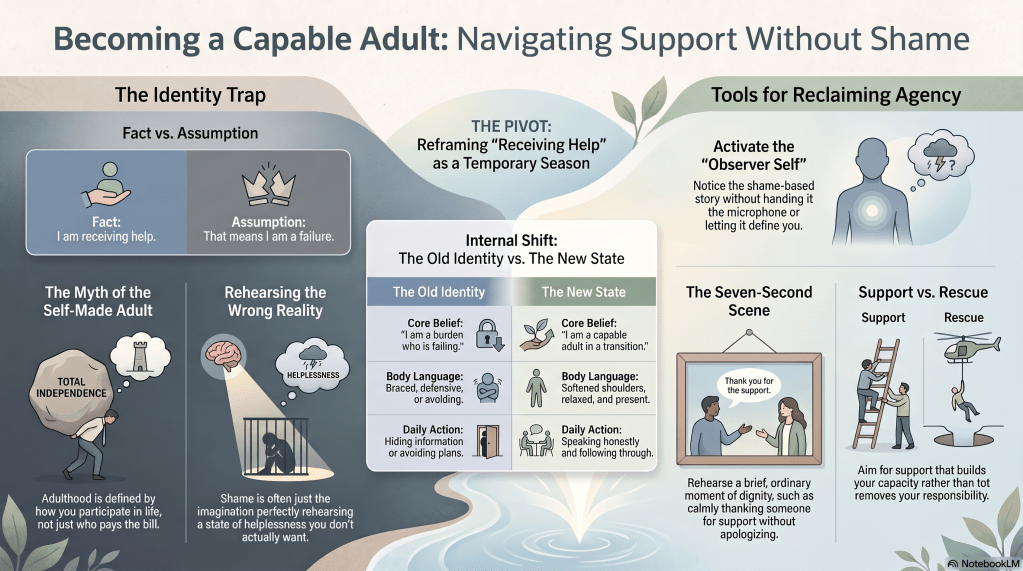
The Myth of the Completely Self-Made Adult
Modern culture has created a strange definition of adulthood.
A successful adult must apparently:
Pay every bill alone.
Never move back home.
Never borrow money.
Never need childcare help.
Never have a bad year.
Never call a parent unless it is to announce a promotion, engagement, home purchase, or particularly successful sourdough starter.
But human beings have never really lived like this.
Families have always shared homes, food, labor, money, childcare, knowledge, and resources.
Multigenerational support is not a glitch in civilization.
It is civilization.
Independence can be valuable.
Isolation is not the same thing.
And this is where I keep coming back to my own children.
I do want them to become more independent. I want them to feel capable of handling their lives. I want them to know they can make decisions, recover from mistakes, and build something solid.
But I do not want the price of that independence to be shame or loss of self-esteem.
I do not want them to believe that needing help means they have failed some invisible adulthood exam.
A Paycheck Is Not a Maturity Certificate
Money is easy to use as the main measurement of adulthood because it is visible.
A bill is either paid or it is not.
Emotional maturity is messier.
Someone can earn a large salary and still avoid accountability, punish people with silence, explode when told no, and expect everyone else to clean up their emotional messes. (I pictured somebody specific just now, did you?)
Someone else may receive financial help while being honest, respectful, responsible, and actively building greater stability.
Adulthood is not defined only by who pays the bill.
It is also revealed in how you communicate, respond to limits, keep commitments, make decisions, and use the support you receive.
That matters to me as a parent.
What I want is not simply for my children to stop needing help.
What I really want is for them to know how to receive help without losing their dignity or their sense of agency.
Listen to the Full Conversation
In Episode 142 of Vibrations and Manifestations, Alicia and Jared explore the shame that can arise when adults need financial help from family. They use Neville Goddard’s teachings, the observer self, and a practical seven-second imaginal scene to help listeners feel capable and supported without denying financial reality.
Listen to Episode 142 and try the guided visualization.
The Inner Rehearsal Room
Neville Goddard taught that imagination creates reality.
That phrase can sound grand, mystical, and slightly like someone is about to sell you a crystal subscription box.
But the useful version is much more practical.
Imagination is where you rehearse who you believe you are.
You do this all day.
You replay arguments while brushing your teeth.
You imagine your parents sounding disappointed before you call.
You picture rejection before anyone has actually rejected you.
You anticipate criticism with impressive emotional commitment.
You are already very good at imagining.
The problem is that you may be rehearsing an identity you do not want.
If your inner scene is:
“They think I’m irresponsible,”
you enter the conversation tense and defensive.
If your inner story is:
“I am a burden,”
even a neutral question may sound like judgment.
Imagination does not merely create a fantasy.
It prepares a posture.
The Observer Self
When shame appears, most people either believe it completely or fight it aggressively.
Neither works especially well.
A gentler move is to notice it.
Instead of:
I am a failure.
Try:
I notice that I am telling myself I am a failure.
That tiny wording change creates space.
The first sentence is an identity.
The second is an observation.
You are not pretending the thought is gone.
You are simply refusing to hand it the microphone, the spotlight, and full creative control of the evening.
What “Feeling Is the Secret” Really Means
“Feeling” does not mean forcing yourself into ecstatic positivity.
You do not need to feel wealthy while opening a past-due notice.
You do not need to shout affirmations until your neighbors become concerned.
The more useful goal is naturalness.
A new identity begins to feel ordinary.
For example:
I am capable and currently supported.
That statement may not create fireworks.
It may simply help your shoulders drop.
It may help you speak more honestly.
It may help you plan without collapsing into shame.
The goal is not to feel invincible.
The goal is to stop feeling disqualified from adulthood.
The Financial Shame Audit
Choose one situation that carries shame and work through these five steps.
1. Name the fact
Keep it plain.
My family is helping with my rent for three months.
2. Name the meaning
What have you attached to it?
I am moving backward.
I am disappointing everyone.
3. Name the identity
Who do you become in the story?
The burden.
The irresponsible child.
4. Notice the behavior
Do you avoid the numbers?
Hide information?
Become defensive?
Delay applications?
Snap at people asking reasonable questions?
5. Choose a more honest identity
Not a fantasy.
Something grounded.
I am a capable adult receiving temporary support.
I can be grateful without making myself smaller.
I am still directing my life.
The Seven-Second Scene
Now give your mind a new scene to rehearse.
Keep it ordinary.
Not:
You win the lottery and arrive at Thanksgiving in a helicopter.
Instead:
You finish a calm conversation about money.
Your shoulders are relaxed.
You look at the plan in front of you and say:
Thank you. I understand what I am responsible for next.
That is enough.
Include:
- First-person perspective
- One sensory detail
- One emotional quality
Maybe you notice the texture of the paper, the warmth of a coffee mug, or the click of a laptop closing.
The feeling might be clarity, dignity, or relief.
Not ecstasy.
Just enough calm for the new state to feel possible.
Support Is Not the Same as Rescue
This is the part I am still working through myself.
Healthy support tends to increase agency.
It may provide stability, time, safety, childcare, education, or a temporary bridge.
Rescue is different.
Rescue removes every consequence, avoids hard conversations, and can keep everyone stuck.
A useful question is:
What is this help making possible?
Another is:
Is the person receiving help participating in the solution?
And another:
Can everyone involved speak honestly about limits?
Those questions matter on both sides.
The person receiving help needs dignity and room to act like an adult.
The person offering help needs permission to have boundaries without being cast as unloving.
Support does not require perfection.
It does require clarity.
When Help Comes With Family Drama
Sometimes the shame is not entirely internal.
Sometimes money is used as leverage.
Sometimes support comes with criticism, reminders, and a lifetime subscription to unsolicited decision-making.
Changing your inner identity does not mean pretending that is healthy.
It means responding from the adult state you want to occupy.
That may sound like:
I am grateful for the help, and I am willing to discuss the practical terms. I am not willing to participate in conversations that attack my character.
Gratitude and boundaries can exist in the same room.
They may not be friends, but they can coexist.
The same is true for parents.
A parent can say:
I love you, and I can help with this.
And also:
I cannot pay for that.
Those two statements do not cancel each other out.
Your Three-Night Experiment
For the next three nights, practice your seven-second scene before sleep.
Play it once or twice.
Feel one sensory detail.
Notice one emotional quality.
Then release it.
Do not lie awake wondering whether you manifested correctly.
That is simply anxiety wearing a spiritual hat.
In the morning, ask:
What support can I receive responsibly today?
And:
What is one step I can take for myself?
Both matter.
Receiving and participating.
Support and agency.
Connection and growth.
You Are Still a Real Adult
Maybe adulthood is not never needing help.
Maybe it is knowing how to receive help without disappearing inside the shame of it.
Maybe adulthood means:
Saying what is true.
Respecting limits.
Keeping agreements.
Taking the next step.
Allowing love without turning it into a verdict.
You can be supported and self-directed.
You can be grateful and still have boundaries.
You can be a work in progress without being a failed project.
And yes, you are still a real adult.
Look for more helpful videos on our YouTube channel Vibrations and Manifestations
The FAQs
Does receiving financial help make me less independent?
Receiving help creates some degree of practical dependence, but it does not automatically erase emotional maturity, responsibility, or agency. Independence is also reflected in how you communicate, respect limits, follow through, and use the support you receive.
What is the difference between support and rescue?
Support creates stability while encouraging responsibility and growth. Rescue repeatedly removes consequences, avoids difficult conversations, or prevents someone from developing necessary skills.
How can I accept financial help without feeling ashamed?
Begin by separating the factual circumstance from the identity attached to it. “My family is helping with rent” is a fact. “I am incapable” is an interpretation. Practice receiving help with gratitude, clarity, and an understanding of what you remain responsible for.
What does Neville Goddard mean by “feeling is the secret”?
In this context, feeling does not require intense excitement or forced positivity. It means allowing a desired identity—such as capable, responsible, and supported—to feel increasingly natural and familiar.
Can I set boundaries with someone who is helping me financially?
Yes. Financial assistance may reasonably involve clear terms and shared decisions, but it does not justify humiliation or attacks on your character. Gratitude and healthy boundaries can coexist.

 Vibrations and Manifestations
Leave a comment