
Another person’s good news can quietly become bad news about you, but their milestone is not a verdict on your life.
How to Stop Using Someone Else’s Timeline Against Yourself
You open your phone for a quick scroll and, within minutes, you have seen a friend’s engagement photos, a former coworker’s promotion announcement, and someone you went to school with standing in front of a beautiful new house, proudly holding up the keys.
You tap the heart. You write congratulations. You mean it.
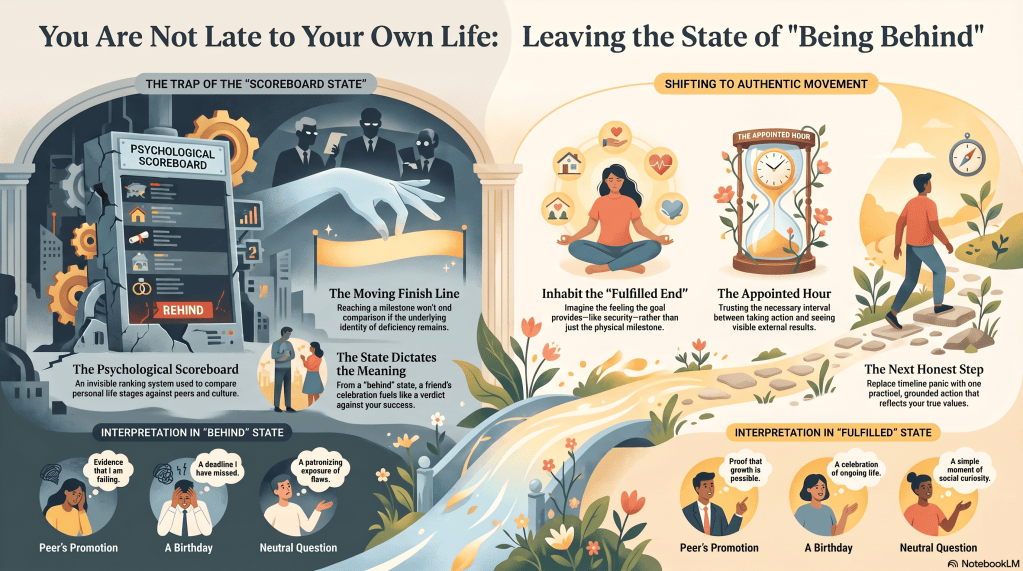
Then, almost before you notice what is happening, an invisible scoreboard lights up in your mind. Their relationship appears to be moving forward. Their career seems established. Their finances look secure. Their life appears to be taking shape, while yours suddenly feels unfinished or stalled.
That is one of the most painful tricks of comparison: someone else’s good news quietly becomes bad news about you. An engagement is no longer simply an engagement. It becomes evidence that you are running out of time. A promotion becomes proof that you wasted your potential. A new home seems to confirm that everyone else understood adulthood before you did.
The announcements are real. The verdict is something your mind added.
Listen to Episode 143
In What If You’re Not Behind in Life?, Alicia and Jared explore why adulthood can feel like a competition without a syllabus. They discuss social comparison, invisible progress, genuine versus borrowed desire, and Neville Goddard’s teachings on states of consciousness, revision, persistence, and the appointed hour.
Listen to the full episode, then return to this Field Guide to complete the Timeline State Audit and Seven-Day Comparison Reset.
The Scoreboard Nobody Agreed To
Adulthood does not come with a syllabus. Nobody hands you a grading rubric that explains what you should have accomplished by 29, 36, 45, or 62. There is no universal sequence that every successful life must follow.
Still, most of us carry an internal schedule. By now, I should be married. By now, I should own a home. By now, I should have a stable career, earn more money, or finally know what I am doing.
That schedule may have come from your family, your culture, your school friends, social media, movies, religion, or a plan you made when you were much younger. You may also be measuring your life against expectations formed during an earlier generation, when housing, education, careers, and family life operated under very different conditions.
Even when the schedule no longer fits reality, the shame attached to it can remain. You stop saying, “I have not bought a house,” and begin saying, “I am failing at adulthood.” You stop saying, “I am still deciding what I want professionally,” and begin saying, “I have wasted too much time.”
Those statements may feel inseparable, but they are not the same.
When Feeling Behind Becomes a State
Neville Goddard taught that we move through life in different states of consciousness. A state is more than a temporary mood or a single discouraging thought. It is an identity containing its own assumptions, expectations, emotional reactions, and interpretations.
When you occupy the state of being behind, almost every experience begins to support it. A birthday feels like a deadline. A wedding invitation feels like an evaluation. A family question sounds like criticism. Rest begins to feel irresponsible, and a delayed reply to an application seems to confirm that nothing is working.
Even your own progress becomes difficult to see because it does not match the categories displayed on the scoreboard.
Perhaps you left an unhealthy relationship, returned to school, recovered from an illness, or rebuilt after a divorce. Maybe you spent the past year learning to set boundaries, regulate your emotions, ask for help, or become more honest about what you actually want. Those changes may have transformed your life, but they do not always produce photographs, certificates, job titles, or public announcements.
There is no glossy social-media post for learning not to abandon yourself. That does not mean the growth is insignificant.
Why the Next Milestone May Not Fix It
It is easy to believe that comparison will stop once you finally achieve the next major goal. Once you receive the promotion, you will feel successful. Once you buy the house, you will feel settled. Once you find a partner, you will no longer feel left behind.
Sometimes a milestone does bring genuine relief. It can improve your life, create opportunity, or fulfill a meaningful desire. But if the underlying state remains unchanged, the scoreboard often finds somewhere else to place you behind.
You buy a house, but someone else owns a larger one. You get married, but your friends already have children. You finish the degree, but someone younger has a more impressive position. You receive the promotion, but someone else earns more.
Winning one category does not end a game that can invent new categories forever.
The deeper work, then, is not simply catching up. It is leaving the state that keeps turning every stage of life into a race.
Is It Your Desire or a Borrowed One?
None of this means you should stop wanting meaningful things. You are allowed to desire love, family, financial security, education, recognition, meaningful work, a home, or greater independence.
A more useful question is whether you want the experience itself or the relief you imagine it will provide from shame.
You may want a home because you value privacy, stability, and the freedom to create a space that feels like yours. You may also want one because you feel embarrassed about renting or living with family. You may want a relationship because you value intimacy and shared life, while also longing to stop being seen as “the single one.”
Most desires contain a mixture of genuine longing and social pressure. You do not have to judge yourself for that. You only need enough honesty to recognize when panic is trying to make the decision for you.
Ask yourself whether you would still want this if nobody saw the announcement. Do you want the ordinary daily reality of the milestone, or mainly the public symbol? Are you moving toward something meaningful, or trying to escape how you currently feel about yourself?
The answers may be uncomfortable, but they can help you build a life that fits rather than one designed to look complete from the outside.
Living From the Fulfilled End
Neville Goddard encouraged people to live from the feeling of the fulfilled desire. This is sometimes misunderstood as pretending that you already possess something you do not have or ignoring the practical facts of your life.
A more grounded application begins by asking what inner state you believe the milestone will finally give you.
Perhaps you believe a home will make you feel secure. A partnership will make you feel chosen. A promotion will make you feel respected, or a degree will finally make you feel legitimate.
Once you identify that deeper state, you can begin practicing it before the public proof arrives. You might learn what it feels like to respect your own direction, to feel engaged rather than stalled, or to trust yourself to continue. You may begin to experience your life as something already in motion instead of waiting for a future accomplishment to officially begin it.
This does not replace action. It changes the place from which you act.
Instead of applying for a job because you are ashamed of your current title, you apply because the work interests you and supports the life you want. Instead of rushing into a relationship because the clock feels loud, you look for a connection that genuinely fits. Instead of making a major purchase to prove adulthood, you create a realistic financial plan.
You still move forward, but shame is no longer driving the car.
Making Peace With the Unfinished Middle
Neville also spoke about an interval between accepting a direction inwardly and seeing the completed result. He sometimes called this the appointed hour.
A seed does not appear to be growing while it is still beneath the soil, but that does not mean nothing is happening. Adult life contains many similar unfinished periods: saving for a down payment, applying for jobs, returning to school, dating without knowing where it will lead, recovering financially, rebuilding after divorce, or developing a creative project that has not yet found an audience.
The unfinished middle is difficult because it offers little public proof. You may be taking meaningful, responsible steps without having anything dramatic to announce. During that period, someone else’s arrival can make your preparation feel insignificant.
It is not insignificant.
At the same time, trusting the interval does not mean waiting passively. You still make the appointment, submit the application, look honestly at the numbers, learn the skill, and have the necessary conversation. Trusting your path does not mean abandoning the clock. It means refusing to use every unfinished moment as evidence that you have failed.
The Timeline State Audit
Choose one milestone that reliably triggers comparison and give yourself enough time to answer these questions honestly.
What do I believe I should have achieved by now?
Be specific. Perhaps you believe you should already be married, own a home, have a stable career, live independently, earn a certain amount, or have completed your education.
Notice the phrase “by now.” It often reveals a deadline you have accepted without examining it.
Where did this deadline come from?
Consider whether it came from family expectations, social media, your culture, a former partner, an economic reality that no longer exists, or a plan you created when you were very young.
You are not looking for someone to blame. You are trying to determine whether the schedule still belongs to you.
What do I imagine this milestone would prove?
Would it prove that you are lovable, responsible, successful, safe, mature, or finally a real adult?
The milestone may improve your life, but it cannot permanently settle every question you have about your worth.
Which state do I enter when I think about this timeline?
Complete the sentence:
When I think about this timeline, I become the person who ________.
You may discover that you become the person who always takes too long, disappoints everyone, misses opportunities, or watches life happen for other people.
Naming the state helps you see that it is a position you are occupying, not the total truth of who you are.
How does that state influence my behavior?
Does it make you rush into decisions, hide from people, settle for poor options, overspend, procrastinate, or abandon something you genuinely value? Does it make you withdraw from friends because their happiness is painful to witness?
The state is not only affecting how you feel. It may also be shaping the very choices that determine what happens next.
What is the fulfilled state beneath the milestone?
Instead of naming the object or achievement, name the deeper experience you want. Perhaps you want to feel secure, chosen, respected, connected, engaged, or at home in your own life.
Then ask what one small action that version of you would take next.
You do not need the entire plan. You need one honest step.
The Invisible Progress Audit
Now make a list of progress that would never appear in a milestone announcement.
You may have left an unhealthy relationship, rebuilt after divorce, returned to school, learned emotional regulation, cared for a family member, recovered from illness, created community, developed a creative skill, traveled to new places, or become more financially honest. Perhaps you learned to ask for help, stopped abandoning yourself, or began again with better information.
This progress is real, even when nobody applauds it.
There is one important caution, though. Invisible progress should not become a flattering explanation for never acting. Ask yourself whether your inner growth is helping you move more honestly or giving you a reason to remain permanently still.
A sustainable life requires both internal development and outward participation.
Revising a Comparison Moment
Neville’s practice of revision can be helpful when a painful interaction continues replaying in your mind.
Imagine that someone asks a question that triggers shame:
Are you thinking about buying a home soon?
Are you dating anyone?
When are you going to finish school?
What are you doing for work now?
You do not need to pretend the question was never asked. Instead, revisit the experience and imagine responding from a different state.
Feel your feet on the floor or the glass in your hand. Let your shoulders relax. Hear yourself answer without apology:
Not yet. I’m building a few things in my own order.
Or:
My path has changed, and I’m taking the next step now.
Perhaps you say:
I’m still working that out, but I feel much clearer than I did last year.
End the scene feeling calm, connected, and intact.
The purpose is not to falsify history. It is to stop carrying one painful interpretation into every future interaction. Instead of remembering, “Everyone could see that I was failing,” you begin carrying, “I can speak about my life without apologizing for it.”
A Seven-Second Scene
Create one brief scene that implies you are no longer living for the scoreboard.
You might imagine sitting with a trusted friend who looks at you and says:
You seem more like yourself lately.
You feel the warmth of a mug in your hands and answer:
I stopped trying to make my life look on time.
Another scene might involve closing your laptop after submitting an application. You hear the quiet click, take a breath, and think:
This is my next step. It does not have to be everyone else’s step.
Keep the scene simple and sensory. Do not imagine defeating anyone. Imagine no longer needing to.
A Seven-Day Comparison Reset
For the next week, notice one comparison trigger each day. Name the state it activates, then identify one form of invisible progress you have been overlooking.
Choose one genuine desire and take one practical action connected to it. Before sleep, revise the comparison moment and spend a few seconds in your chosen imaginal scene.
You can use these questions each day:
What am I using as evidence that I am behind?
What state am I entering?
What is one way my life is moving today?
What is my next honest step?
You Do Not Need the Entire Timeline
You may still feel envy or sadness when someone receives something you deeply want. You may have legitimate concerns about time, money, health, family, or opportunity. This practice does not require you to pretend those concerns are meaningless.
It asks you to stop turning them into your entire identity.
Another person’s milestone may give you information. It may clarify something you want or even inspire you to act. But it is not a verdict on the value or future of your life.
You are allowed to want more without hating where you are. You can take responsibility without humiliating yourself, and you can celebrate someone else without abandoning your own path.
The scoreboard was never the road. Your life is still here, and your next honest step is still available.
Take that one.
More excellent topics await you at Vibrations and Manifestations, so join us!
FAQ Section
Why do I feel behind even when I am making progress?
You may be measuring progress only through visible milestones such as marriage, homeownership, promotions, income, or degrees. Emotional healing, rebuilding, education, caregiving, creative growth, and learning better boundaries may be less visible, but they still shape the life you are creating.
Does trusting my own timing mean I should stop pursuing goals?
No. Trusting your timing is not passive waiting. It means taking practical, responsible action without using shame or comparison as your primary motivation.
What did Neville Goddard teach about feeling behind?
Neville described people as occupying states of consciousness. From the state of being behind, ordinary events are interpreted as proof of failure. His practices encourage choosing and returning to a state that reflects the person you intend to become.
What is living from the fulfilled end?
Living from the fulfilled end means identifying the inner experience beneath a desired milestone—such as security, belonging, or self-respect—and beginning to act from that state before the external result is complete.
What is Neville Goddard’s revision practice?
Revision involves revisiting a painful event in imagination and experiencing it with a healthier response and meaning. It does not erase history; it helps prevent one difficult moment from becoming a permanent identity.

 Vibrations and Manifestations
Leave a comment