
Listen to Episode 145: Why Is It So Hard to Make Friends as an Adult?
In the full episode, Alicia and Jared explore the psychology behind the liking gap, Neville Goddard’s ideas about inner conversations and self-concept, and why recurring spaces may be one of the simplest ways to build real friendship as an adult.
How to Make Adult Friendship Feel Possible Again
There is a uniquely adult kind of awkwardness that happens when you walk into a room full of people who seem to already know each other.
You have not even taken off your coat yet, and your brain has already produced a full documentary called:
Everyone Here Has Friends Except Me.
There is a group laughing in the corner. Someone is hugging someone else. Two people are clearly mid-story.
And suddenly you are thinking:
They all came together.
I’m interrupting.
I’ll just stand over here and look at my phone like I have very important international business to attend to.
Then you go home and say, “See? Nobody talked to me.”
This is one of the sneakiest things about adult loneliness.
Sometimes the room is hard.
Sometimes the schedule is hard.
Sometimes the culture really is cliquey.
But sometimes we are also walking in with a story about our own rejection already loaded and ready to go.
And that story changes how we show up.
First, Adult Friendship Really Is Harder
This part matters because we do not need to turn loneliness into a character flaw.
When we were younger, friendship had infrastructure.
School gave us the same people, in the same place, at the same time, over and over again.
You sat next to someone in biology.
You complained about the cafeteria food together.
You both hated running laps in gym.
Congratulations. Friendship had begun.
Adult life is very different.
We commute alone. We work remotely. We wear headphones at the gym. We grocery shop with purpose. We go home to our own spaces.
All those accidental hours of repeated contact disappear.
And research on friendship formation helps explain why that matters.
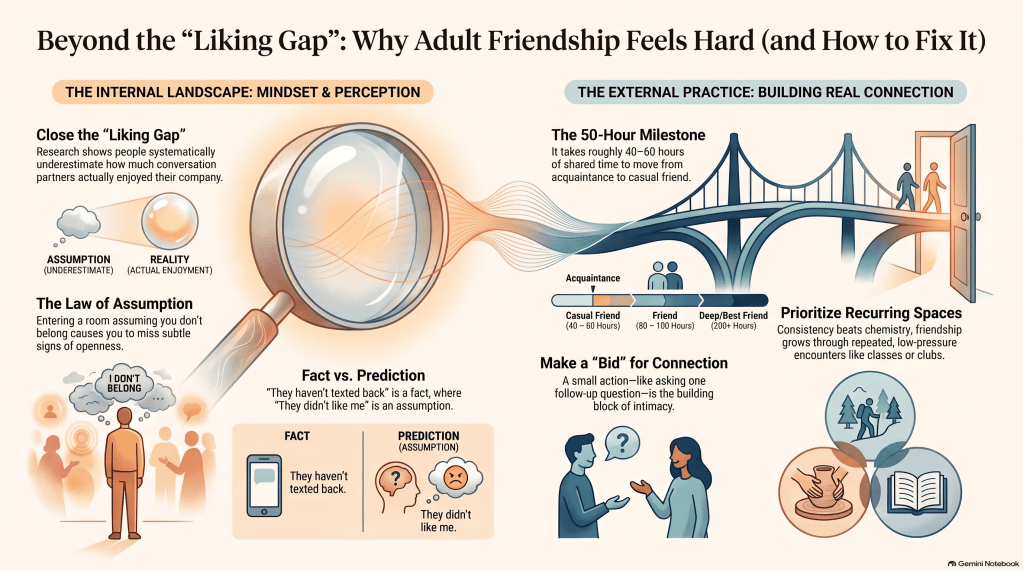
Studies suggest it can take around 40 to 60 hours together to move from acquaintance toward casual friendship.
Which means that slightly awkward coffee where you both talked too much about work?
That may not have been a failed friendship.
That may have just been Hour Three.
I love that idea because it removes a lot of unnecessary drama.
You do not have to decide whether someone is “your person” after one lunch.
You may simply need more reps.
Then There’s the Story We Bring Into the Room
In the episode, Alicia talks about taking a pottery class because she was lonely and wanted to meet people.
Perfect plan.
Then she arrived.
Three women were already laughing together near the kiln.
And within seconds, Alicia’s brain announced:
They already know each other.
They don’t want a beginner hanging around.
I’m going to be the weird extra person.
So she sat down at her pottery wheel, kept to herself, avoided eye contact, and gave a tight little smile when someone approached.
Later?
“Nobody really talked to me.”
Technically true.
But incomplete.
Because Alicia had already started behaving like someone who wanted to be left alone.
This is where Neville Goddard’s idea of inner conversations becomes useful.
Not because your thoughts secretly control everybody in the pottery studio.
They do not.
But because the story you rehearse changes the person who walks into the room.
If the story is:
I am an imposition.
You may make less eye contact.
You may speak more quietly.
You may avoid asking questions.
You may leave early.
And then other people, being normal humans who cannot read your mind, may interpret that behavior as:
“Oh, she probably wants some space.”
Now your brain gets to say:
See? I knew it.
Very efficient.
Terrible for friendship.
Your Brain Is Also Kind of a Jerk About This
There is research on something called the liking gap, and it is both comforting and mildly infuriating.
People tend to underestimate how much other people enjoyed talking with them.
You leave the conversation thinking:
Why did I tell that story?
I talked too much.
I definitely sounded weird.
Meanwhile, the other person may be thinking:
“She was fun.”
We have access to all our internal awkwardness.
They do not.
They just see us smiling, listening, asking questions, and occasionally saying something strange because that is how conversations work.
So instead of trusting every anxious interpretation, try separating the fact from the story.
Fact:
They have not texted me back yet.
Story:
They regret ever meeting me.
Fact:
Nobody approached me for the first fifteen minutes.
Story:
Nobody wants me here.
Fact:
They turned toward someone else during the conversation.
Story:
I bored them so badly they are planning an escape.
Your brain loves certainty.
Even fake certainty.
A better response is often:
I actually don’t know yet.
That sentence can save you a lot of suffering.
Try the Social Assumption Audit
Before your next social situation, ask yourself five questions:
- What am I already predicting?
“Nobody will talk to me.” - What am I afraid they will think?
“I’m awkward.” - How does that belief change my behavior?
“I look at my phone and avoid eye contact.” - What neutral things am I interpreting as rejection?
“They took six hours to text back.” - What assumption would help me participate instead?
Notice that the replacement does not have to be:
Everyone adores me.
Your nervous system may respond to that with, “Sure, Jan.” (Assuming your name is Jan).
Try something believable:
I am allowed to participate.
I do not know what they think yet.
Other people may be nervous too.
I can be curious instead of impressive.
That is enough.
Make One Bid
You also do not need to walk into your next community event with the goal of acquiring three lifelong friends before dessert.
That is exhausting.
Make one bid for connection.
Ask one follow-up question.
Sit next to somebody.
Tell someone you liked talking with them.
Send the follow-up text.
Invite the acquaintance to coffee.
Go back to the same class next week.
One bid.
Then let the other person respond.
This is also where we need to distinguish between initiating and chasing.
You do not need perfect 50/50 initiation from the beginning.
Some people are terrible initiators and wonderful responders.
What matters more is reciprocity over time.
Do they answer warmly?
Do they ask questions back?
If they cannot come, do they suggest another time?
Do they seem happy to hear from you?
That is very different from repeatedly sending energy into a black hole.
The Best Friendship Hack Is Boring
It is not a clever opening line.
It is not charisma.
It is not becoming mysteriously fascinating.
It is:
Keep showing up.
Recurring spaces are incredibly useful for adult friendship because they recreate the conditions we used to have automatically.
A weekly class.
A volunteer shift.
A walking group.
A book club.
A community organization.
A gaming group.
A choir.
A pottery class where you eventually stop pretending to be deeply fascinated by your phone.
Friendship often grows because two people keep appearing in the same place until “the person from Tuesday pottery” becomes “the person I always sit with” and eventually becomes “my friend.”
Not glamorous.
Very effective.
Your Seven-Day Connection Experiment
For the next week, try this:
Notice one social assumption each day.
When you catch yourself mind-reading, ask:
What do I actually know?
Then replace certainty with curiosity.
Make one small bid for connection.
Follow up when it feels appropriate.
And before you go to sleep, spend a few seconds imagining one simple scene that implies connection is possible.
Not a giant party.
Not twelve new best friends.
Maybe you are putting on your coat after a class and your phone lights up:
It was really nice talking with you. Let’s do that again.
That is enough.
One Last Thought
When you walk into a room and see people laughing together, it is easy to assume everyone else has already completed their friendship hours.
They are full.
They are established.
They do not need anyone else.
But what if that is not true?
What if the person across the room is also in their own awkward Hour Three?
What if they are wondering whether they belong?
What if they are hoping somebody else will make the first move?
You do not have to be the most confident person in the room.
You do not need everyone to like you.
You do not even have to stop feeling awkward.
You just need to leave enough room for something new to happen.
You do not have to be chosen before you participate.
Try this:
One assumption I’m ready to stop bringing into social situations is: __________
One small bid for connection I can make this week is: __________
Join us at Vibrations and Manifestations for great videos with tips and tools, visualizations, affirmations, sleep guides, and more!


Leave a comment